
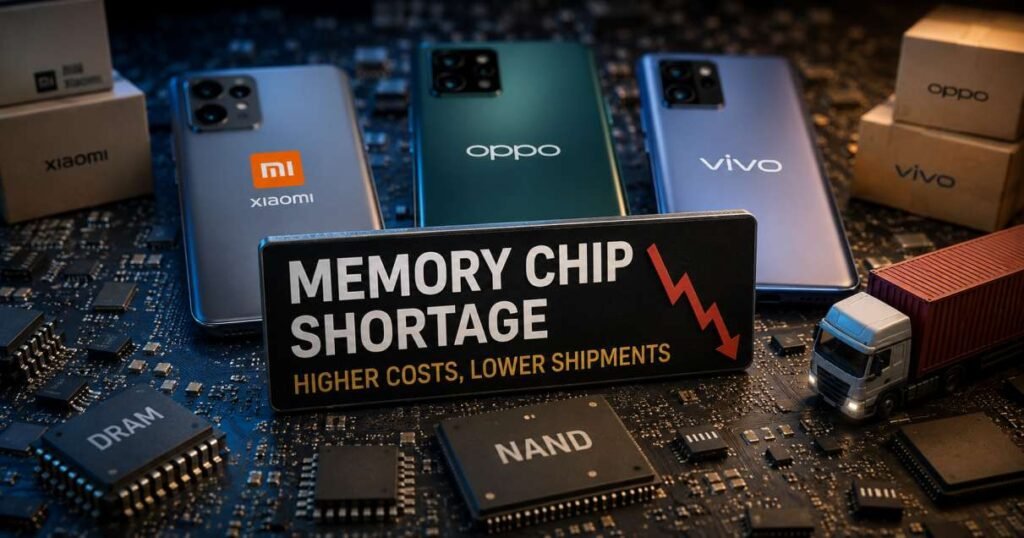

Memory Chip Shortage are happening across the globe, forcing some key players in the smartphone industry, such as Xiaomi, Oppo, and Vivo, to cut component costs, reshaping companies’ plans. Reports on the internet claim that these players reduced their shipment targets due to a significant increase in the price of smartphone memory chips.
According to reports, consumer electronics are affected by sudden changes in the semiconductor industry. We all know the future is of AI; that’s why almost all tech investors are working to build AI infrastructure. But on the other side, the smartphone industry is struggling across the supply chain due to a shortage of memory components.
Why Memory Chip Shortage Forces Xiaomi, Oppo and Vivo to Cut Shipments by Up to 30%
Prices for DRAM and NAND flash memory have risen recently. These are key components of memory chips that store data and enable devices to run apps smoothly.
Smartphone makers are struggling to secure sufficient supply at stable prices because memory component suppliers are focused on producing chips for AI servers and high-performance computing systems.
According to reports, the challenge of high manufacturing costs was addressed by Xiaomi, Oppo, and Vivo by increasing production of phones. These news items surfaced from experts rather than the companies themselves; the experts said this is a cautious approach to an uncertain market.
It’s not just a parts shortage problem; it shows how AI is influencing the industry, and it goes beyond data centres. Smartphone companies are left at the mercy of a few suppliers because high investments in AI hardware have increased the demand for advanced chips.
What This Means for Smartphone Buyers
For Consumers, noticeable changes are expected at the end of this year, but the immediate impact will not be dramatic. By the time of a major model launch or seasonal sales, lower production targets will be set for certain mobile models.
Another side of the situation is that limited supply could lead to higher phone prices due to high production costs. What will happen depends on competition and demand.
Challenges are always there, not the first, so the competition among brands remains intense. These companies are still investing in new features such as improved cameras, battery technology, and AI-powered software to attract more customers, even as they plan to slow production.
Industry Outlook about Memory Chip Shortage
The semiconductor industry is under great pressure due to several disruptions over the past few years; therefore, many manufacturers are more cautious about estimating production units.
At present, memory availability has improved because the market is reshaping itself with a large number of investments in AI infrastructure.
According to reports, demand for AI hardware will remain strong in the future, while keeping pressure on memory supplies. Chip manufacturers are not silent here; they are investing in production to increase availability and stabilise demand.
Smartphone manufacturers consider component availability when planning production. They are assessing current market conditions and, instead of trying to maximise shipments, will adjust their production strategies.
The Memory Chip Shortage Forces Xiaomi, Oppo and Vivo (together) to cut their shipments by up to 30% serves to remind us all that these major players are really interconnected in the global technology industry.