
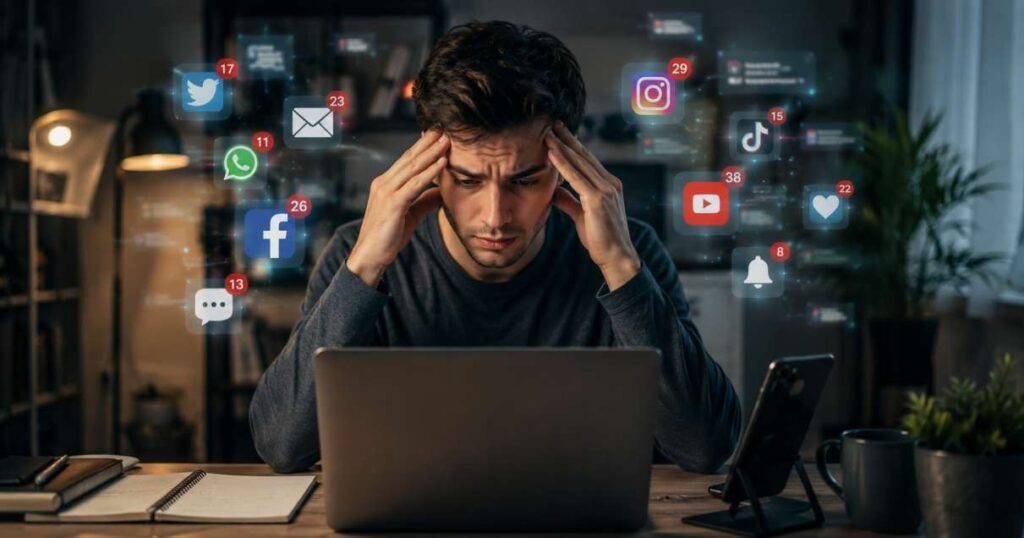

Many individuals are asking the question Why Is Focusing So Difficult In The Age Of The Internet? The pace of life is so fast that, with time = money, everything we use, from smartphones to social media to notifications, occupies our attention for every second of our existence.
No matter what you want to do, like trying to finish a certain project or having to read a book, it’s harder to do than a decade ago.
The internet has just changed our way of communication, and not only this, but how we learn and solve problems. At the time of its creation, it was built to make our daily communication easy, but now it’s transformed into an environment where everything is just a constant digital distraction.
The internet created habits that cause a rapid shift in attention, rather than deep concentration, through short videos to checking messages every few minutes.
According to research, we well know our brain is remarkably adaptable. By default, our brain is programmed by nature to learn new skills, but daily routines also shapes our behavior, thinking process, remembrance, and focus.
Why Our Brains Struggle to Stay Focused
Brain plasticity is a term used to describe the way the human brain adapts and can change through learning. Repeatedly performing behaviours causes the neural pathways responsible for them to strengthen.
When we use and change back and forth from one task to another by constantly going from apps to e-mail and social networking we are creating an environment for our brains to be accustomed to frequent changes in the tasks we perform.
App notifications are one of the causes of distraction. Sometimes our phone just buzzes, causing a distraction and making it harder to get back to the original task.
Repeated interruptions build up the habit of consistent phone checks rather than sustained attention.
If we talk about experts and what they might think, here neuroscientists point to dopamine, a chemical responsible for motivation and reward.
As we all know, if we praise or reward a child for certain behaviour or action, then it becomes obvious. The same thing works on teens and adults in the form of New messages, likes, and fresh content; those are responsible for a satisfying feeling and encourage them to repeat the process when they intend to stop.
What Research Says About Attention Today
Studies found that people do digital multitasking because it’s difficult to ignore distractions. Most of us think the internet is damaging our focus and mental health, which is factually incorrect; rather, it’s constant switching between apps that reduces efficiency and causes mental fatigue.
Researchers have found that people try to access more and more, and at last become information overloaded, which affects how we process and remember details. Before the internet, we usually stored info nd now we depend on search engines to retrieve information later; it’s known as “digital memory outsourcing.”
Scientists are continuously trying to find out how the internet actually influences our concentration. But they all suggest that we balance our technology use to stay healthier than either complete avoidance or nonstop connectivity.
What Experts Recommend
If we follow psychologists’ and neuroscientists’ insights, they all agree on developing a healthier lifestyle with technology rather than abandoning ourselves with it.
Their recommendations include:
Use technology consciously and cautiously.
You need to set up boundaries regarding social media use.
A certain part of the day set as notification-free time.
Remember to take breaks while using screens.
Prioritise healthy sleep over the phone.
Plan physical games so you get face-to-face interactions.
Make a plan for day activities and adopt it as a daily routine to stay focused.
IF you want to bring back your focus and healthy lifestyle, then you have to strictly follow these strategies.
Frequently Asked Questions
Does social media reduce attention span?
If we talk about a person’s attention span, then it can’t automatically shorten by Social Media, but consistent switching between apps, messages, notifications, posts and videos can slowly make it harder to concentrate for a long time.
Can attention span improve again?
Indeed, the same way we diminish the attention span, it could improve again by removing distractions, decreasing screen time, and doing a single task at a time.
How much screen time is considered healthy?
Actually, no universal limit is yet set for adults. However, Experts suggest balancing screen time with physical activities, quality sleep, face-to-face interactions with friends and family and less digital multitasking.
Conclusion
It’s a new era where every way is redefining itself due to the internet: work, learn, and connect. However, it’s introduced us to new challenges for concentration.
Technology itself isn’t an enemy to humanity. The problem lies in how we choose to use it.