
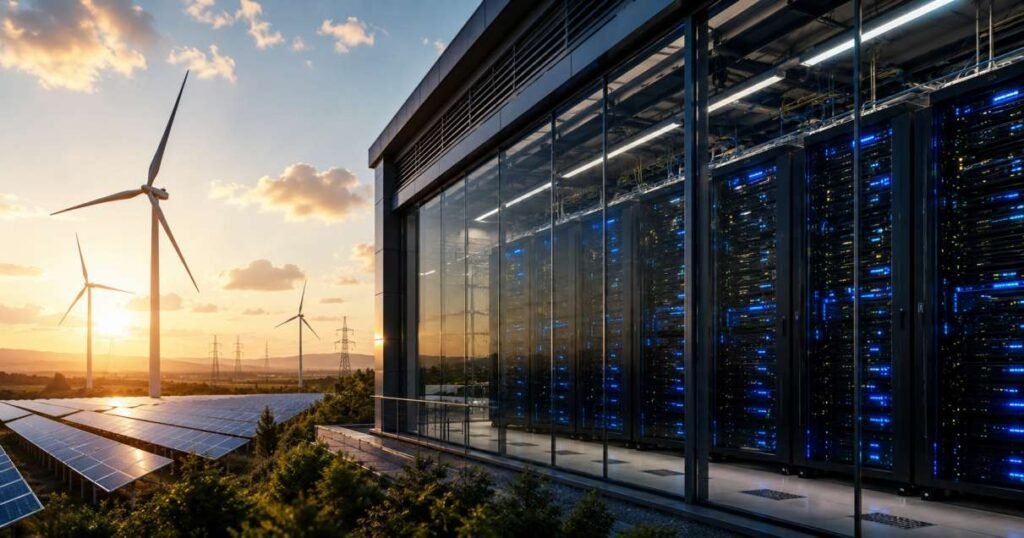

Microsoft is like other firms that seek carbon neutrality. The company is planning to achieve its target in 2030. Although the company’s policies have received recognition, its own statistics tell the opposite.
Carbon emissions have risen since the company scaled up its AI infrastructure, as the Microsoft AI tries to meet surging demand for AI(artificial intelligence) by building up massive data centers to satisfy energy demands.
Why Microsoft’s Emissions Are Rising
Running AI and building new infrastructure require a massive amount of power; that’s the simplest answer we can give. Microsoft is finalizing billions of dollars in deals to build data centers not only in America but also in Europe, Asia, and beyond.
Wherever a data center is built, it requires steel, concrete, and heavy construction—all of which produce significant emissions before any server goes online. Power is needed throughout the day and night to run AI workloads and keep hardware cool.
With growth spurting like no other, companies and users of Microsoft AI products like Azure OpenAI and Copilot have increased. This results in more power used and more emission of carbon dioxide.
What the 25% Figure Actually Means
As per reports from Microsoft itself, carbon emissions increased during the period 2020-23 by approximately 29%, which clearly refers to the time when the company accelerated investment in AI infrastructure. The company made a policy to decrease emissions, but actions clearly increased emissions; that 25% dent moved the company away from reducing emissions by 2030.
| Metric | 2020 Baseline | Recent Figures | Change | |—|—|—|—| | Total carbon emissions (CO₂e) | ~11.6M metric tons | ~15.3M metric tons | ~+29% | | Data center electricity use | Lower | Significantly higher | Rising | | Renewable energy coverage | ~60% | ~42% (2023) | Declining share |
The amount of renewable energy usage has dropped considerably and cannot be overlooked. Microsoft AI the company seems to be buying more renewable energy on paper, the demand for electricity has skyrocketed, and thus the share of renewable sources is lower than in 2020.
Why Microsoft AI Is So Energy Intensive
AI models are not regular applications; those were comparatively cheaper to manage than AI.
AI does work on regular systems; instead, AI training requires high-performance GPUs that must run continuously for days, even months. After training, when AI is deployed, millions of consumers generate AI requests, requiring servers to remain online around the clock.
What else these Microsoft AI servers need:
- Large cooling systems
- Continuous power without any disruption.
- Powerful internet
- Massive cloud storage
- Updated Hardware
These things increase electricity use, which creates a larger carbon footprint.
Microsoft’s Response
Microsoft is still repeating that its climate policy remains unchanged, even with the increase in emissions.
The actions taken by the company to decrease its emission levels entail:
The implementation of environmentally-friendly methods of electricity production, the introduction of technologies that remove carbon from the atmosphere, and more efficient usage of data centers and water.
According to information by Microsoft, the amount of electric energy consumed by the company from clean sources will be equal to its emissions by the year 2025. The Microsoft AI sets a target to be carbon neutral by the year 2030.
Industry Context
Microsoft isn’t the only one guilty.
According to sustainability reports, major players’ emissions are increasing as AI infrastructure expands.
What Comes Next
All parties concerned, such as investors and the government, are scrutinizing the company’s capabilities when it comes to increasing clean energy production.
Clean energy is important for a bright tomorrow.